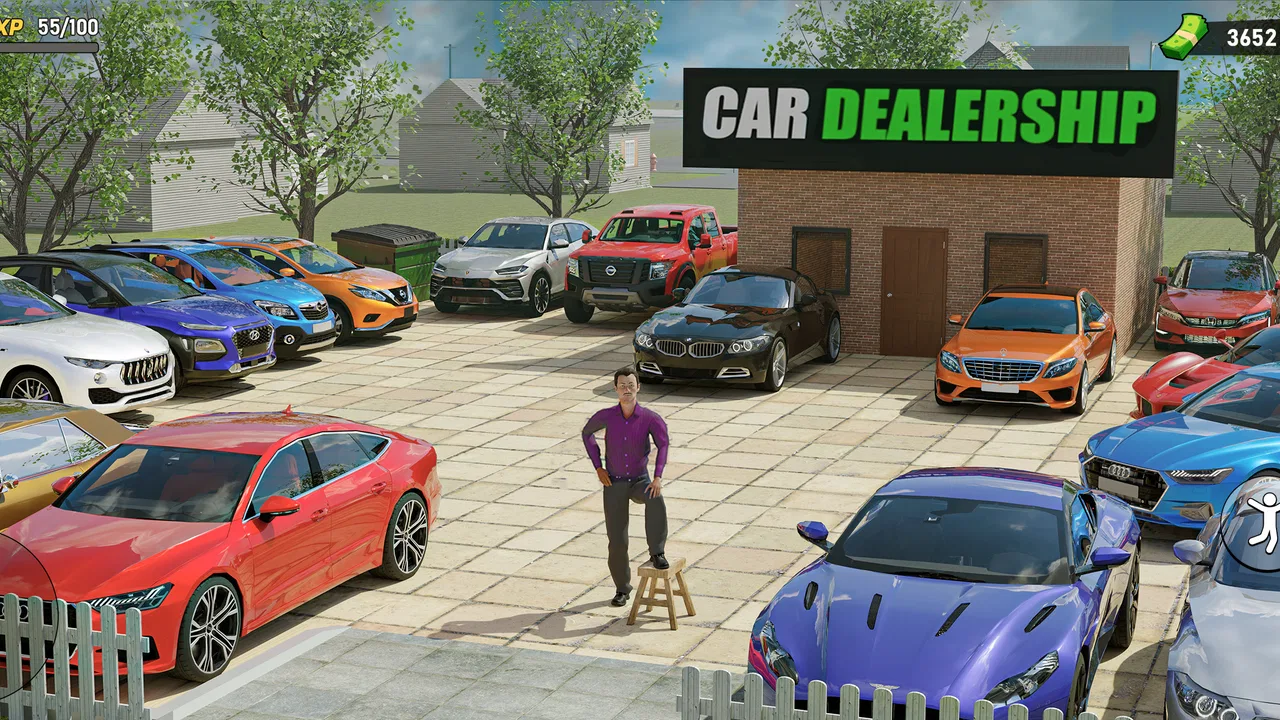
Car Dealership Business Game
- 4.3
- Rating
- 10.00M
- Installs
- Free
- Price

 Analysis by App-foxy
Car Dealership Business Game is the kind of simulation I open when I want a small business challenge rather than a long, complicated management game. I step into the role of a dealer, look for cars to buy, decide what deserves repair or modification, and try to sell each vehicle for enough to keep the business moving. That simple loop is easy to understand, but it gives every purchase a little weight: spending too much on a tired car can leave less room for improvements, while selling too quickly can mean missing a better return.
After spending time with it, I see the game as a relaxed, mobile-friendly take on car trading simulation. It is made by InfinityGames Studio, available for free, and suitable for Everyone. The current version is 1.1.29, and it runs on devices using Android 7.0 or later. Those details make it approachable for a wide range of phones, although the experience still depends on how comfortably a particular player can read small interface elements and handle repeated touch actions.
The audience response is encouraging without suggesting that the game will suit everybody: it holds a 4.2 average from around 279 thousand ratings, with more than 10 million installs. I think that popularity makes sense because the basic idea is immediately familiar. You do not need to understand complicated financial terminology or learn a large set of controls before making your first decision. The real question is whether the short, repetitive dealership cycle gives you enough variety over time.
You May Also Like

 Blood Strike: 2.5 Anniversary
Blood Strike’s Loadouts Turn Every Drop Into a Tactical Gamble
A close look at Blood Strike’s custom loadouts: how fast access to signature weapons reshapes its battle royale rhythm, rewards preparation, and narrows the gap between fights.

 Pandora - Music & Podcasts
Pandora’s Music Is Easy to Start, but Harder to Recover
Pandora’s strength is its low-effort path from a seed to a station. Its weak spot is how much confidence it asks you to place in connection, setup, and quiet recovery.

 8 Ball Pool
 Is Built on Rivalries, Rematches, and Routine
A close look at the rivalries, rematches, shared routines, and unanswered safety questions that turn a quick pool match into a persistent mobile community.

 Samsung Music
’s Quiet Strength Is Playing What You Already Own
Its reach comes less from spectacle than from dependable access to a personal library. That simplicity is both the app’s strongest retention engine and its ceiling.

 AccuWeather: Weather Radar
AccuWeather Review: A Quick, Clear Forecast for Everyday Decisions
For everyday plans, the best forecast is the one you can understand quickly. AccuWeather makes rain timing, radar, and local conditions easy to act on, with a few trade-offs.

 Hill Climb Racing
Why Hill Climb Racing Still Turns Crashes Into One More Run
A tiny car, a bumpy hill and one more upgrade: Hill Climb Racing keeps resurfacing because its simple chaos makes every near-miss feel personal.
More From Our News Desk



How the dealership loop feels in everyday play
I find the dealership loop most enjoyable when I treat each car as a decision, not just another item to process. A quick check of what needs attention before committing to repairs or modifications helps me keep the business moving without spending automatically. That small pause makes the everyday rhythm feel more considered, and it sets up a closer look at how those choices play out in practice.
Readable goals and an easy starting point
The strongest part of the design is how quickly the purpose becomes clear. I am not asked to manage an entire transport company or memorize a large catalog of systems. The focus stays on buying cars, improving them, and selling them. That narrow scope helps the game feel less intimidating than many business simulations, especially for someone who normally avoids management games because of crowded menus and too many numbers.
For a first session, I would approach each vehicle as a small project. I look at the opportunity in front of me, consider how much attention it needs, and avoid treating every available car as an automatic bargain. A vehicle that needs work may become more valuable after repairs or modifications, but it also ties up resources and time within the game’s progression. That creates a useful decision: do I want a safer, faster sale, or am I willing to take a more involved route for a potentially better result?
The interface is generally easier to follow when I concentrate on one task at a time. I find the experience more comfortable when I pause to inspect the available choices instead of tapping through quickly. This is an important point for new players: the game is simple, but simple does not mean every decision should be rushed. The best early habit is to read the current vehicle information, identify what kind of work it needs, and only then commit resources.
Navigation that favors short sessions
Car Dealership Business Game works well in the gaps of an ordinary day. I can play for a few minutes while waiting for an appointment, then put it down without losing the thread of the dealership. The individual actions are compact, and the game does not require the same uninterrupted attention as a large strategy title. That makes it a good fit for players who want a casual business game rather than a second job on their phone.
A realistic example is a short evening session after work. I might check the cars available, choose one that fits my current budget, improve it, and sell it before moving on. If I have more time, I can compare several opportunities and think about how to balance quick turnover against more ambitious projects. The game gives that ordinary routine a satisfying structure: inspect, invest, improve, and decide when the result is good enough to sell.
That structure also reveals one of the game’s limitations. If I am looking for a deep dealership sandbox with broad market research, detailed negotiation, or a large staff-management layer, this is not the right choice. The experience concentrates on the vehicle transaction loop instead of trying to reproduce every part of running a real showroom. I appreciate the focus, but players expecting a full business-management package should lower their expectations before installing it.
Making repairs and modifications matter
The repair and modification elements give the basic buying-and-selling idea more texture. Without them, the game could feel like a sequence of price checks. With them, I have a reason to think about the condition of a car and the value of putting additional effort into it. The important trade-off is not simply “upgrade everything.” A sensible dealer has to consider whether the money spent on a vehicle will be reflected when it is sold.
My practical advice is to avoid improving a car just because an option is available. I first consider the role that vehicle is playing in my current plan. If I need money moving quickly, a modest intervention may be more sensible than a full makeover. If I am comfortable waiting longer within the game’s progression, a more developed project can be more rewarding. This approach turns modifications into a budgeting decision rather than a checklist.
Another useful habit is to separate experimentation from routine income. I like keeping some decisions conservative so the dealership can continue operating, while using another opportunity to test how much repairs or modifications change the outcome. That way, one uncertain choice does not dominate the whole session. It is a small strategy, but it makes the game feel less random and helps me learn its economy through play.
Where it differs from other simulation games
Compared with a city builder, this game has a much narrower management view. I am not balancing roads, citizens, utilities, or multiple industries. Compared with a racing game, the cars are business assets rather than machines I drive through competitive events. And compared with a detailed vehicle mechanic simulator, the focus is not on performing every repair step manually. The appeal comes from the commercial decision between acquisition, improvement, and resale.
That distinction matters when choosing it from the simulation category. Players who enjoy watching a small operation grow may find the dealership theme more immediately rewarding than a generic idle business game. On the other hand, anyone who wants realistic automotive diagnostics or a highly technical repair process will probably get more from a dedicated mechanic title. I would describe this game as a light business simulation with cars, not as a comprehensive automotive simulator.
Readability, navigation, and different visual needs
For readability, the game benefits from its focused subject matter. I am usually dealing with a vehicle and a small number of related decisions rather than navigating a huge map. That reduces visual clutter compared with many management games. Still, mobile screens vary widely, and information that feels comfortable on a larger display may require more concentration on a smaller phone. I would recommend using the largest comfortable text and display settings supported by the device, while remembering that system-level enlargement can sometimes change how much of a game screen is visible.
Navigation is easiest when I treat the game as a sequence of clear stages instead of trying to scan everything at once. I inspect the car, review the available action, and return to the business decision. This workflow is helpful for players who find dense interfaces tiring. It also reduces accidental taps because I am less likely to press through a choice before understanding it.
There is a trade-off here: a streamlined interface can be welcoming, but it may leave less room for players who need very large labels or strong visual separation. I would not assume that a clean screen automatically solves every readability issue. Someone with reduced vision may still need a larger device, a brighter environment, or shorter play sessions. The game’s accessible feeling comes mainly from its limited scope, not from any specific certification or specialized accessibility system.
Motor comfort and sensory load
The dealership concept does not demand the rapid reactions associated with racing or action games. I can make decisions at a calmer pace, which is a meaningful advantage for players who find fast tapping difficult. The main physical demand comes from repeated touch interaction: selecting vehicles, choosing actions, and moving through the business cycle. For many people, that will be manageable, but players with hand fatigue or limited precision may still notice the repetition.
I find it more comfortable to use deliberate taps rather than trying to move quickly through the menus. A stable grip and a device placed on a table can make short sessions easier than holding the phone in one hand for a long time. Taking breaks is especially sensible when the game settles into a repeated buy-repair-sell rhythm. The relaxed pace helps, but it does not remove the physical effect of repeating the same gestures.
Sensory demands appear lower than in games built around flashing effects, loud action, or constant competition, because the central activity is business planning. Even so, a player sensitive to visual movement or busy presentation should judge the game on their own device and settings. I would begin with a brief session rather than assuming that a quiet simulation will be comfortable for every sensory profile.
For players who use assistive input, the most important practical question is whether their device can reliably select the game’s interactive areas. I would not promise that every alternative controller, switch setup, screen reader, or magnification tool will work smoothly. The game is designed around ordinary mobile touch interaction, so compatibility may vary. That is not a reason to dismiss it, but it is a reason to test the opening portion before investing much time.
Playing in different situations
The short-session format is one of the most useful qualities for situational access. I can play in a quiet room, during a break, or while traveling, provided I have enough attention to read the current choices. It is less suitable when I am walking, multitasking, or frequently interrupted. Even though the actions are not fast, making a poor purchase because I was distracted can affect the next part of the dealership cycle.
This is also where the free entry point helps. I can try the game without paying upfront and decide whether its pace suits me. The game includes in-app purchases ranging from $0.99 to $29.99 per item, so I would treat optional spending carefully, particularly if I am playing with a child or trying to keep mobile entertainment within a fixed budget. The Everyone age rating makes the game broadly approachable, but age suitability and spending comfort are still separate decisions.
Because the game is about repeated commercial choices, it can work well for someone who enjoys low-pressure planning during a commute or lunch break. It is not ideal for a player who wants a complete story, a social competition, or a highly varied activity every time they open the app. The same focused loop that makes it easy to enter can make it feel predictable when I am in the mood for novelty.
I also recommend considering attention and decision fatigue. The game is gentle enough for a short break, but a long session may turn the dealership into a sequence of similar evaluations. I get more from it when I set a small goal, such as improving one vehicle or reaching the next stage of my business, rather than continuing without a clear stopping point. That approach makes the experience feel purposeful and reduces the chance that repetition will become the main thing I notice.
Remaining barriers and practical trade-offs
The biggest barrier is not the theme; it is the possibility that the core loop will not offer enough depth. Players who need extensive customization, complex financial forecasting, or detailed vehicle knowledge may find the game too light. The repair and modification decisions add useful strategy, but they do not turn the app into a professional dealership-management tool.
Another limitation is that the value of a decision may not always be obvious at first glance. New players can be tempted to spend on a car without understanding how that choice fits their wider cash flow. My solution is to make smaller commitments early, observe how the sale changes the next opportunity, and only then become more ambitious. This learning-by-testing approach is more reliable than assuming every available improvement is automatically profitable.
In-app purchases are another point to consider. The free download lowers the barrier to trying the game, but the presence of paid items means families should discuss spending rules before handing the phone to a child. I would also avoid judging progress by how quickly another player advances. The most enjoyable way to play, in my experience, is to treat each sale as a business puzzle rather than chasing a perfect result.
Device context can create smaller barriers too. A compact screen may make reading vehicle information less comfortable, and frequent touch input may not suit someone with limited dexterity. Players who need guaranteed support for a particular accessibility tool should test the game directly on their own setup. The game’s calm pace and focused interface are helpful, but they should not be confused with universal accessibility.
Who should try it, and who should skip it
I would recommend Car Dealership Business Game to someone who likes casual simulations, enjoys comparing risk and reward, and wants a car-themed activity that can be understood quickly. It is especially appealing if you enjoy the feeling of turning an imperfect purchase into a better sale. The game also suits players who prefer planning over reflexes and who like making several small decisions instead of one complicated long-term strategy.
I would be more cautious recommending it to someone who wants realistic mechanical work, a detailed showroom, or a broad management system involving employees, locations, and market conditions. A traditional racing game is a better fit if the pleasure comes from driving. A technical mechanic simulator is better if examining and repairing components is the main attraction. A larger business simulator will offer more depth if you want to manage many connected systems at once.
For younger players, the Everyone rating makes the theme approachable, but I would still keep an eye on optional purchases. For older players or anyone who finds small touch targets uncomfortable, the best test is a short hands-on session on the intended device. The game’s low-pressure pace may help, yet the repeated interaction and screen readability remain personal concerns.
My inclusive verdict after using it
Car Dealership Business Game succeeds because it gives the familiar car-buying fantasy a clear business purpose. I enjoy deciding whether a vehicle deserves investment, choosing when an improvement has gone far enough, and watching a sale support the next opportunity. InfinityGames Studio has kept the concept approachable, and the free-to-try model makes it easy to find out whether the loop matches your taste.
From an inclusive point of view, its strongest qualities are the calm decision-making, limited scope, and suitability for short sessions. Those features can make it easier to approach than a fast action game or a crowded management simulator. The remaining barriers are equally important: repeated touch input, possible readability issues on small screens, uncertain compatibility with specialized controls, and a gameplay loop that may become repetitive for players seeking constant variety.
My recommendation is to try it as a focused, low-pressure car business game rather than expecting a complete dealership simulator. If you enjoy careful spending, modest upgrades, and the satisfaction of turning a questionable purchase into a sensible sale, it is worth exploring. If you need deep automotive realism, extensive accessibility customization, or a constantly changing challenge, another simulation will probably serve you better. For the right player, however, Car Dealership Business Game offers an easy-to-enter way to think like a dealer without demanding racing reflexes or a large time commitment.
FAQs for Car Dealership Business Game
01What is the objective of Car Dealership Business Game?
The primary goal of Car Dealership Business Game is to build and manage a successful car dealership business. Players are tasked with buying, selling, and upgrading cars, while strategically managing resources and finances to maximize profits and expand their operations. Success depends on making smart business decisions and understanding market trends.
02Is Car Dealership Business Game free to play?
Car Dealership Business Game is free to download and play, but it may offer in-app purchases for players who wish to enhance their gameplay experience. These purchases can include additional resources, exclusive cars, or premium features. However, players can enjoy the core game without spending any money.
03What platforms is Car Dealership Business Game available on?
The game is available on both Android and iOS platforms, ensuring a wide range of accessibility for smartphone and tablet users. Players can download it from the Google Play Store for Android devices or the Apple App Store for iOS devices, making it easy to start building their car dealership empire.
04Does Car Dealership Business Game require an internet connection?
While Car Dealership Business Game can be played offline, certain features, such as leaderboards and online events, require an internet connection. Playing online also ensures that you receive the latest updates and content enhancements, providing a more dynamic and engaging experience.
05What age group is Car Dealership Business Game suitable for?
Car Dealership Business Game is designed for players aged 12 and up. It offers a blend of strategy and simulation that can appeal to both teenagers and adults. The game’s content is family-friendly, focusing on business management and decision-making skills without any inappropriate material.
Pros
- Engaging gameplay with realistic dealership scenarios.
- Variety of cars to buy and sell enhances strategy.
- User-friendly interface makes navigation easy.
- Regular updates keep the game fresh and exciting.
- Multiplayer mode for competing with friends.
Cons
- In-app purchases can become costly over time.
- Requires internet connection for most features.
- Occasional ads can disrupt gameplay experience.
- Limited customization options for dealerships.
- Progression can be slow without premium currency.

Car Dealership Business Game
Gallery